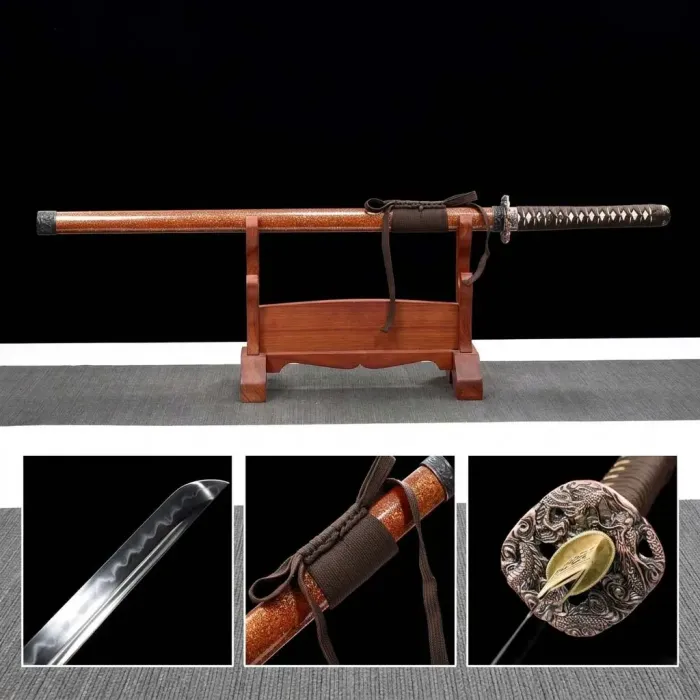
A heritage oriental sword serves as a beautiful expression of ingenuity, but consider if you want to manifest your distinct manner? Personalizing your weapon is a enriching journey, allowing you to forge a truly uncommon piece. From the grip wrapping and binding to the handpiece design and marking, each component offers a chance for unique expression. This survey delves into the realm of katana revisions, providing insights for both starters and well-versed enthusiasts pursuing to inscribe their impression on the long-standing art of the samurai.
1060 Steel Katanas: The Beginner's Legitimate Fabrication
For people ready to embark on the rewarding journey of historical swordplay, 1060 steel katanas offer an superior entry point. This specialized grade of tool steel balances a suitable blend between price and capability . While lacking compared to hard as premium steels, 1060 supports a fair level of whetting, making it appropriate for newcomers to cultivate the preliminaries of blade care and admire the allure of classic Japanese weaponry. It’s a first-rate choice for building experience without the budgetary burden of more specialized steels.
Type T10 Edges : Managing Functionality and Value
Satisfying specialists seeking an authentic katana experience without breaking the budget , T10 alloy katanas represent a compelling option. These tools offer a noticeable improvement in toughness compared to cheaper alternatives, exhibiting good edge retention and adequate flexibility for introductory slicing techniques. While not rivaling the superior characteristics of higher-grade steels like T100 or folded compound, T10 provides a effective blend of capacity and budget-friendly nature , making them a sought-after choice for initiates and those on a fixed financial .
Transcending the Edge : Customizing Your Weapon's Accessories and Shaft
Even though the honed blade is undeniably the important point of a katana, truly improving its presence lies in the careful customization of its features and hold. This art allows owners to communicate their distinct style . Review the broad possibilities: menuki - decorative decorations that supply visual appeal ; the hamon enclosures – often intricately crafted ; the tsuka essence itself, wrapped in genuine ito twine ; and the fusa stopper , which can be formed from various fabrications like ornaments or bone .
- Adopt styles that echo with you.
- Test with different ingredients .
- Emphasize strength for a enduring mark .
The Allure of the Katana: History, Craftsmanship, and Steel
That katana contains a matchless allure, steeped in epochs of Far Eastern history and tradition . More than merely a instrument of skirmishing, it's a representation of the knight ethos – a fusion of prowess and restraint . Its growth spanned score generations, with early steel evolving into the polished curvature and effective edge we acknowledge today. The fabrication involved is truly impressive , requiring years of study to excel at . The process involves a sophisticated folding of tamahagane , creating layers that strengthen the edge’s flexibility and shaving ability. Various schools of blacksmithing appeared , each with their separate secrets and techniques for achieving the ultimate stability and precision - a truly exacting pursuit.
- Former Katana forms
- The function of the nihonto in fighter culture
- Heritage fabricating procedures
Determining the Fitting Steel for Your Katana Project: 1060 vs. T10
Selecting the right steel is critically important for any blade project, and the selection between 1060 and T10 can be challenging. 1060 is a widely used American material, offering a acceptable balance of toughness and hardiness, rendering it quite easy to work. However, T10, a from Japan steel, typically boasts better wear endurance and can potentially achieve t10 steel katana a higher final hardness, although it can be relatively laborious to treat and requires thorough heat annealing. Consider your proficiency and projected results: for a beginner, 1060 may be a safer inception, while the veteran smith might prefer the extra properties of T10.
- Accessibility of Operating
- Erosion
- Conclusive Durability
Revealing the Strength: Expert Katana Improvement Strategies
Honing the expertise in edge customization extends far beyond basic whetting. Serious experts are now delving into advanced techniques to truly expose a blade's hidden potential. This features intricate work with the temper pattern, utilizing specialized compositions for differential condition and carefully determining the design of the defense plate to optimize balance and handling. Beyond purely functional tweaks, artisans are increasingly focused on attaining unparalleled aesthetic appeal, through complex cutting and layered surfaces that truly transform a katana into a artistic composition.
Forging a 1060 Katana: From Raw Metal to Masterpiece
The journey opens with ordinary 1060 compound , a rigid material far apart the polished katana it will shift into . Experienced bladesmiths carry out a intricate process of stacking and shaping the rough steel, repeatedly heating it and forging it to purify impurities and develop a symmetrical grain structure. This laborious process, often persisting for days , builds the required force and pliability characteristic of a bona fide Japanese tool. Subsequent heat adjustments , including precise hardening and quenching , are fundamental to achieve the desired harmony of sharpness, persistence and magnificence.- Layering: Minimizes impurities and generates grain structure.
- Forging: Models the steel into the initial blade form.
- Conditioning: Regulates the final hardness and flexibility.
The Ongoing Allure of the Katana: Detailed Survey of Metal and Enhancement
Every traditional katana endures a potent symbol signifying Japanese style , its draw far extending beyond mere martial implements . Forged from distinctive steel and regularly featuring intricate ornaments , the way of creation itself is a venerated art. Beyond the foundational craftsmanship, the ability to personalize a katana - from the temper line to the hilt wrapping and guard - grants for a authentically individual representation for both devotees and handlers alike. This union of legacy steelwork and boundless personalization effectuates the katana's continued prestige across the terra .
